I am not familiar with the interfaces that exists in other languages, so i will try my best to explain what interfaces are in golang
Introduction
by now you should be knowing the terms , concrete type, and abstract type
here are some quick pointers
concrete type
- specifies exact representation of its values (struct layout, slice header, pointer, etc.)
- exposes that the intrinsic operations of that representation (arithmetic for numbers, or indexing,append and range for slices)
- may also provide additional behaviour through its methods
- zero value is well defined
abstract type
- reveals only some of their methods
- hide the underlying representation
- cannot see underlying nil pointers without assertion
- no built-in operations
- you have a value of interface type, means you know nothing about it until you assert it
interfaces are of abstract types
there are different built-in interfaces that go uses extensively
Declaration
type CustomInterface interface {
    CustomMethod(p []byte) string
}
an interface type specifies a set of methods that a concrete type must posses to be considered an instance of that interface
to draw parallel from the above declaration, if a type has a method implemented named CustomMethod on it with the same exact signature, then that type can be considered an instance of that interface (or that type satisfies the CustomInterface)
you need not explicitly declare that a type satisfies or implements an interface.just implementing the methods on that type with the same signature and name that the interface declared is sufficient in go. The satisfaction is implicit. A type satisfies an interface if it possesses all the methods the interface requires. neat, right?
you can embed an interface inside an interface
here is an examples from the io package
package io

type Reader interface {
  Read(p []byte) (n int, err error)
}
type Closer interface {
  Close() error
}

type ReadWriter interface {
   Reader
   Writer
}
type ReadWriteCloser interface {
   Reader
   Writer
   Closer
}
intuitively,for a type to satisfy ReadWriter interface should satisfy all the interfaces that are embedded in it.
An empty interface interface {}, places no demands on the types that satisfy it.we can assign any value to an empty interface
Usage
lets see some examples
package main

import "fmt"


type Vehicle interface {
	HasAWD() bool
	HasSufficientClearance() bool
}

type Bike struct {
	NoOfWheels      int
	CC              float64
	GroundClearance int
	HasSpokeWheels  bool
}

func (b Bike) HasAWD() bool {
	// technically current motorcycles does
	// not have all wheel drive,we are just mimicking here
	// treat spoke wheels as AWD
	if b.HasSpokeWheels {
		return true
	}
	return false
}

func (b Bike) HasSufficientClearance() bool {
	return b.GroundClearance >= 210
}

func (b Bike) OnlyOnBike() bool {
	return true
}

type Car struct {
	NoOfWheels      int
	CC              float64
	GroundClearance int
	AllWheelDrive   bool
}

func (c Car) HasAWD() bool {
	return c.AllWheelDrive
}

func (c Car) HasSufficientClearance() bool {
	return c.GroundClearance >= 210
}

func IsOffRoadSuitable(v Vehicle) bool {
	return v.HasAWD() && v.HasSufficientClearance()
}

func main(){

  Ktm390 := Bike{
		2, 398.63, 183, false,
	}
	Ktm390Adv := Bike{
		2, 398.63, 237, true,
	}

	TharRoxx := Car{
		4, 2148.0, 226, true,
	}

	fmt.Println(IsOffRoadSuitable(Ktm390))
	fmt.Println(IsOffRoadSuitable(Ktm390Adv))
	fmt.Println(IsOffRoadSuitable(TharRoxx))

  veh:= Vehicle(Ktm390)
  fmt.Println(veh.OnlyOnBike()) // you cannot call this, explanation below
}
looking at the above code, we have an interface Vehicle which states that it requires 2 methods to be implemented by any type for them to satisfy it.
we also have two struct types Bike and Car which implements these methods hence satisfying the interface.
IsOffRoadSuitable is a function which has a parameter of type Vehicle. since both Bike and Car satisfy this interface we can pass the instances of both Bike and Car as an argument to this function call and that is precisely what we are doing the following lines
consider the below code tho,
veh.OnlyOnBike()
here OnlyonBike is a method only defined on Bike and the interface does not specify anything about this method. so trying to call this method on the instance of an interface would result in a compile-time error. you can also think of this as, veh is of static type Vehicle hence the compiler only allows only those that are listed in the interface
Interface Values
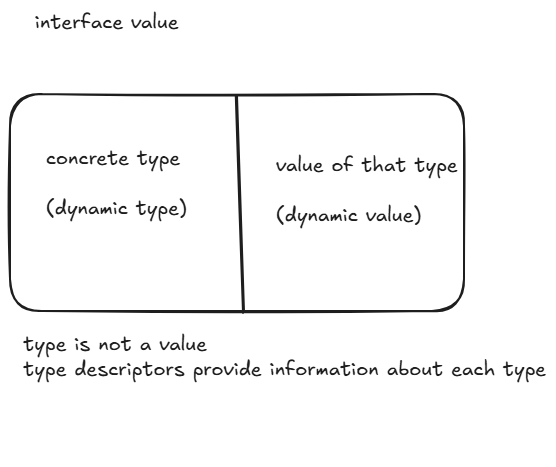
what does an interface value, a value of an interface type actually hold?
well, it has 2 components.
- concrete type
- value of that type
or so called in golang
- dynamic type
- dynamic value
the type component in the interface value is represented by the type descriptor of the concrete type
lets see some examples and print out some types
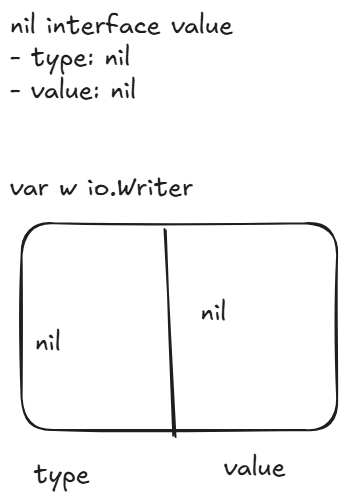
var w io.Writer
io.Writer is a very widely used interface in golang. when declared like above, it assumes the zero-value of the interface which is nil.
for an interface value to be nil, both the type and value components has to be nil.
you can test whether or not the interface is nil using w==nil and w!=nil
let’s change this
w=os.Stdout
os.Stdout is of type *os.File, you can check that using
fmt.Printf("%T\n", os.Stdout) // "*os.File"
*os.File implements a Write(p []byte) (n int, err error) which is required by io.Writer interface and hence that satisfies the interface.
calling Write method on an interface value containing an *os.File pointer causes the (*os.File).Write methods to be called
in this case
w.Write([]byte("ktm 390 duke"))
prints the same string to the stdout (terminal)
looking at some buffers
w= new(bytes.Buffer)
dynamic type is now *bytes.Buffer and the dynamic value is
a pointer to the newly allocated buffer
since *bytes.Buffer also satisfies io.Writer, we can the Write method to append the string to the buffer
w.Write([]byte("wow what a string"))
fmt.Println(w.String())
the above Write method call appends the string to the buffer
Emptiness
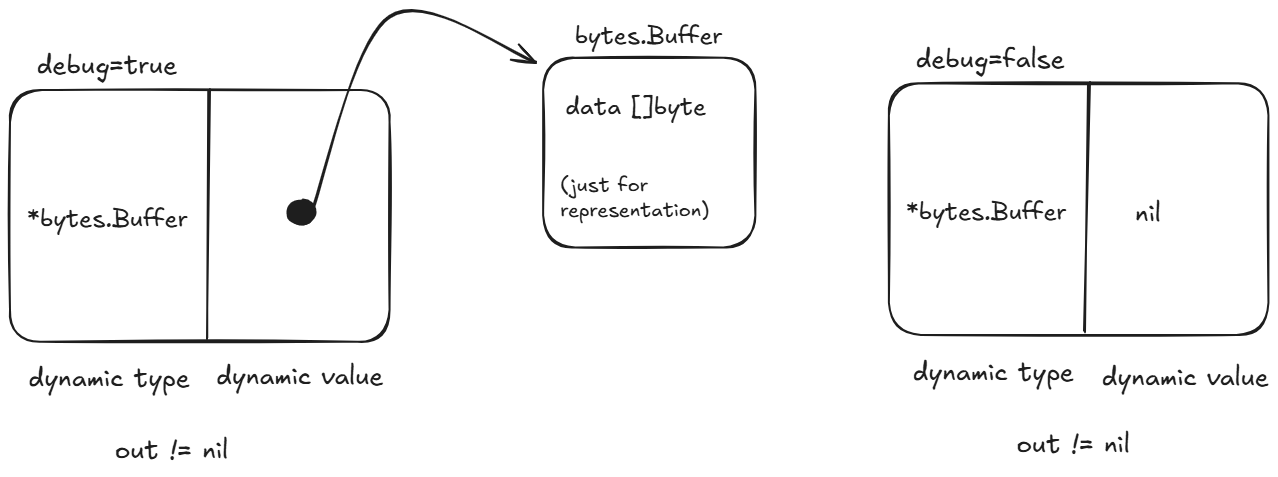
before closing this lets truly understand when an interface value is truly nil and when it’s dynamic value is nil
a nil interface value contain no value at all
i’ll try to explain the distinction with an example direct from the book
const debug = true

func f(out io.Writer) {
  // when debug is true
  // an empty buffer is created
  // when called f(buf), there is
  // dynamic value of out != nil pointer
  //  but a non-nil pointer referring to an empty buffer
  // and to which we can write to
  //   hence this works

  // but if the debug is false
  // the zero value of buffer is passed (nil) to f
  // and the dynamic value of out be nil and
  // not some pointer pointing to an empty memory space,ready
  // to be written
  // hence the error
  fmt.Printf("Dynamic Type of out: %T\n",out)
  fmt.Printf("Dynamic Value of out: %#v\n",out)
  if out != nil {
    out.Write([]byte("f is writing this\n"))
  }
}

func main() {
   var buf *bytes.Buffer
   // originally buf is totally  nil,nil pointer, the zero value of the
   // buffer
  //    fmt.Printf("zero value of the buffer: %#v", buf)
   if debug {
     buf = new(bytes.Buffer)
	 // non-nil empty buffer
	 // now buffer is empty, but not nil
     // buf points to something which is empty,
     // that something has no data yet
   }
   f(buf)
   if debug{
	fmt.Println("content of buffer: " ,buf.String())
   }
}
lets see the results with debug=true
Dynamic Type of out: *bytes.Buffer
Dynamic Value of out: &bytes.Buffer{buf:[]uint8(nil), off:0, lastRead:0}
content of buffer:  f is writing this
when debug=false
Dynamic Type of out: *bytes.Buffer
Dynamic Value of out: (*bytes.Buffer)(nil)
panic: runtime error: invalid memory address or nil pointer dereference
[signal 0xc0000005 code=0x1 addr=0x20 pc=0x7ff6b4c0b977]

goroutine 1 [running]:
bytes.(*Buffer).Write(0x7ff6b4c7f8c8?, {0xc000012198?, 0x7ff6b4c5abe7?, 0x1a?})
        C:/Program Files/Go/src/bytes/buffer.go:182 +0x17
main.f({0x7ff6b4c7f8a8, 0x0})
        C:/Users/Vishnu/Desktop/DEV/golang/the_go_programming_language_book/interfaces/main.go:255 +0x122
main.main()
        C:/Users/Vishnu/Desktop/DEV/golang/the_go_programming_language_book/interfaces/main.go:184 +0x1c
exit status 2
take a look at the dynamic value of out
we can make our f more robust,
func f(out io.Writer) {
	fmt.Printf("%T\n", out)
	fmt.Printf("%#v\n", out)
	if out == nil {
		fmt.Println("truly nil interface")
		return
	}

	if b, ok := out.(*bytes.Buffer); ok && b == nil {
		fmt.Println("out is a typed nil *bytes.Buffer")
		return
	}

	if out != nil {
		out.Write([]byte("done!\n"))
	}
}
here is some visualization to help you
thanks for reading! see you later, once i learn more