I am skipping functions and directly jumping in to methods. I will cover functions in detail but let’s get through methods quickly since it’s relatively a simple topic
If you are coming from any programming language, you are already familiar with methods.
Declaration
A traditional functional declaration in golang is as below
func Greet(name string) string{
    return fmt.Sprintf("hello, %s!", name)
}
When functions are tied to a particular type, they are called Methods (just a funny way of thinking about them). For that to happen there has to be some changes in the way declare method from the way we declare a function
Here is a sample method
Example
type Employee struct {
    ID int
    Salary int
    Designation string
}

func (e *Employee) Promote(newSalary int, newDesignation string){
    e.Salary= newSalary
    e.Designation=newDesignation
}
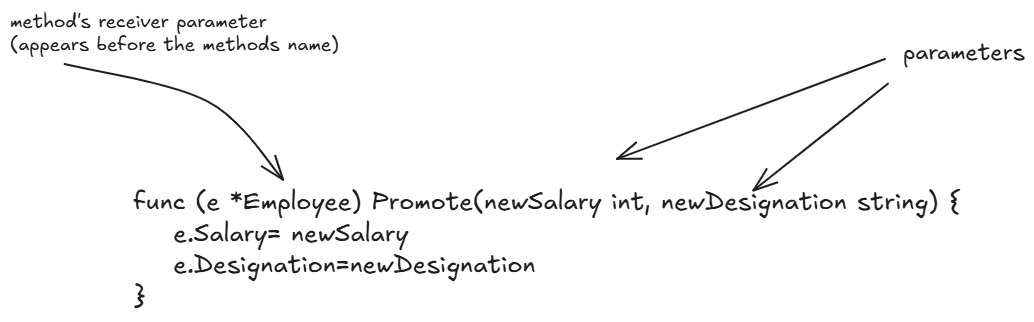
Before moving forward, let’s about the type of receivers we can have for method
- Pointer Receiver
- Value Receiver
what we have above is a pointer receiver.
By using a value receiver, whenever we call a method which has a value receiver, it makes a copy of each argument value which might not be desirable if the arguments are large.
when a method has a pointer receiver, any changes made on the fields of the receiver argument will reflect in the original receiver (because it is pass by receiver)
Let’s create a sample employee
emp:= Employee{
    1, 50000, "IC1"
}
Let’s call the method Promote
emp:= Employee{
    1, 50000, "IC1"
}
&emp.Promote(100000, "IC2")
the above code, &emp.Promote(100000,"IC2") does not work as intended because,in Go, method selection (emp.Promote) happens before any unary operator like & is applied.so the compiler first interprets emp.Promote(100000, “IC2”) as a complete function call expression, evaluates it, and then tries to apply and to the result.
There are few correct ways of using it
Calling a method with pointer receiver
Method 1
empptr:=&emp
empptr.Promote(100000, "IC2")
Method 2
(&emp).Promote(100000, "IC2")
Method 3
the language helps us
emp.Promote(100000, "IC2")
the compiler will perform an implicit &emp on variable emp
Calling a method with value receiver
calling a method with value receiver is simple and self explanatory
lets declare a method with value receiver
func (e Employee) IsFresher() bool{
    return e.Designation == "IC1"
}
using this is simple
fresher:= e.IsFresher()
you can, quite possible call this method on a pointer to the emp instance and go will perform an implicit conversion
empptr=&emp
fresher:= empptr.IsFresher()
Struct Embedding
we had talked about struct embedding and anonymous fields in a struct and the ease of access they provide in my composite data types blog.
the idea here remains the same let’s see how we can compose structs and use the methods of other structs by embedding them
Example
package main

import (
	"fmt"
	"image/color"
)

// Front -> front wheel width in mm
// Rear -> rear wheel width in mm

type Wheels struct {
    Front int
    Rear int
}

type Bike struct {
    Wheels
    Color color.RGBA
}

func (w *Wheels) UpgradeWheels(newWheels Wheels) {
	w.Front = newWheels.Front
	w.Rear = newWheels.Rear
}

func main(){

    // let's define my current bike - rtr 200
    var Rtr200 Bike = Bike{
		Wheels{90, 130},
		color.RGBA{0, 0, 0, 255}, //it's moslty black
	}

	// let's define the bike i want to own in the
	// near future - ktm duke 390
	var Ktm390 Bike = Bike{
		Wheels{110, 150},
		color.RGBA{255, 102, 0, 255}, //THAT ELECTRIC ORANGE LOOKS GORGEOUS
	}

	// let me quickly upgrade the types of my rtr200 to that to duke (don't do this IRL)

	Rtr200.UpgradeWheels(Ktm390.Wheels)
}
now if you print what Rtr200 Wheels are you will see {110,150}
lets look at a few things that are happening here
- we are direclty accessing the method
UpgradeWheelswhich has a pointerWheelsreceiver from an instance of the structBikein which theWheelsstruct is embedded - The methods of
Wheelshave been promoted toBike - we can also access the methods of the
Wheelsin this formatRtr.Wheels.UpgradeWheels(Ktm390.Wheels)
- notice that we are not passing the
Ktm390variable as an argument direclty to theUpgradeWheelscall. that is because the argument thatUpgradeWheelsaccepts is still the type ofWheelsand notBike - to funnily put,
Bikeis notWheels, but it hasWheelsand it has one additional methodUpgradeWheelspromoted byWheels - here is the process by which compiler looks for the declared method named
UpgradeWheelswhen resolving the call to the same method- it first looks for a directly declared method named
UpgradeWheelsonBike - then for methods promoted once from
Bike’s embedded fields likeWheels - then for methods promoted twice from embedded fields within
Wheelsand so on
- it first looks for a directly declared method named
Method Values
When we want to call a method
we select and call a method in the same expression like
e.IsFresher()
the whole idea of method values is that we can seperate these 2 actions and they have nice benifits
the selector
e.IsFresher
yields a method value, a function that binds a method to a specific receiver value e. now the function can be invoked without a receiver value, it only needs the non-receiver arguments.
lets look at an example with a struct which defines a point in a cartesian plane
Example
type Point struct  {X, Y float64}

func (p Point) Slope(q Point) float64 {
    return (q.Y-p.Y)/(q.X-p.X)
}

func main(){
    p := Point{2, 4}
	q := Point{5, 11}

    slopeOfLineWithP:= p.Slope

    fmt.Println(slopeOfLineWithP(q))
}
a silly way to think about this is, assigning functions to a variable in javascript. p.Slope becomes a closure like function, one where p is already captured similar to how js functions can close over variables.
take a look at the signature of slopeOfLineWithP
func(main.Point) float64
Methods Expressions
the usual way we do a method call is , we supply the receiver in a special way using the selector syntax
e.IsFresher()
now what a method expression is , it yields a function value with a regular first parameter taking the place of the receiver and rest all parameters carried so that we ca call it just like we would a function, without any selector syntax, here is an example
i am adding another method to our Point struct named Translate
Example
func (p *Point) Translate(angle float64) {

  oldX := p.X
  p.X = p.X*math.Cos(angle) - p.Y*math.Sin(angle)
  p.Y = oldX*math.Sin(angle) + p.Y*math.Cos(angle)

}
p:=Point{1.5, 7}
q:=Point{3, 9.3}
slope := Point.Slope
fmt.Println(slope(p, q))
// lets look at the signature of the function
fmt.Printf("%T\n", slope)
translate := (*Point).Translate
translate(&p, 2*math.Pi)
fmt.Println(p)
fmt.Printf("%T\n", translate)
take a look at the ouptut
1.5333333333333339
func(main.Point, main.Point) float64
{1.5000000000000018 7}
func(*main.Point, float64)
the function signature of slope and translate are what we expected. since Translate is a method which has pointer receiver , it has a pointer to the struct Point as it’s first paramter
Thank you for reading!